
Open Letter to Minister Paolo Zangrillo (Italy’s Minister for Public Administration)
“Pharmacies as a ‘vital hub’? Minister Zangrillo, have you realised the mess you have created? Simplification must not mean reducing patient safety.”

Dear Minister,
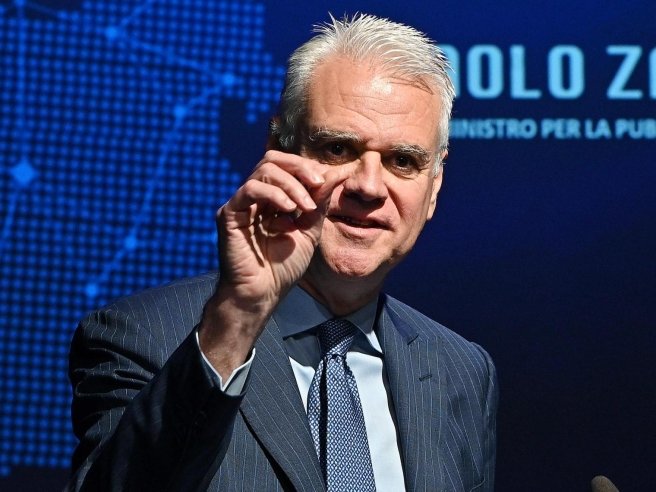
Your statements delivered in San Maurizio d’Opaglio, according to which service pharmacies would now be “at the centre of a simpler and more widespread healthcare system, with diagnostic tests carried out directly in the municipality of residence”, require a public clarification.
Because, given the way the regulatory framework is currently constructed, the real question is not whether healthcare should be closer to citizens – on this we all agree – but at what cost in terms of safety, rules and responsibility.
Before addressing the substance of the matter, one point must be clarified, as it is often presented inaccurately today.
The integration of pharmacies into the National Health Service (SSN) derives from a legislative choice, set out in Article 1, paragraphs 351–356 of Law No. 199 of 30 December 2025 (the 2026 Budget Law).
That provision integrates the services delivered by pharmacies into the perimeter of the SSN, but it does not classify pharmacies as diagnostic facilities, does not equate them with accredited outpatient clinics or laboratories, and does not refer to the healthcare authorisation regime laid down in Legislative Decree No. 502/1992.
For this very reason, speaking generically of “pharmacies as SSN healthcare facilities” without clarifying roles, limits and standards is misleading and creates confusion.
1. You have created two different regimes for the same healthcare service
With the laws approved in 2025, you introduced a situation that is difficult to justify.
If a diagnostic service is paid directly by the citizen (Article 60 of Law No. 182/2025 – the so-called Simplification Law), the pharmacy may operate:
- under an automatic authorisation;
- with the sole requirement that the premises be “hygienically suitable”;
- without any regional authorisation to carry out healthcare activities.
If the same service is paid by the National Health Service (Budget Law No. 199/2025, Article 1, paragraphs 351–356):
- regional planning and certain requirements apply;
- however, the same level of authorisation required of outpatient clinics and diagnostic laboratories is still not expressly mandated.
The outcome is clear to everyone:
- if the citizen pays → almost no requirements;
- if the SSN pays → some requirements;
- if a real diagnostic facility operates → hundreds of necessary and justified requirements, as provided by Legislative Decree No. 502/1992.
The question is inevitable: do patients receive fewer protections in pharmacies? Or are the requirements imposed on all other healthcare providers unnecessary?
2. You have overridden the Regions’ constitutional competence
Through Article 60 of the Simplification Law, pharmacies have been authorised by statute to carry out healthcare activities.
But one fundamental principle appears to have been overlooked: healthcare falls within the competence of the Regions, and only the Regions may authorise the exercise of healthcare activities within their territories, as provided by Article 117 of the Constitution.
It is not possible to:
- integrate pharmacies into the SSN;
- while at the same time removing from the Regions the power to authorise and supervise healthcare activities.
This is not simplification: it is institutional confusion and the creation of a constitutionally fragile system.
3. The Administrative Courts did not say what is now being suggested
Another statement that is often repeated is: “But in December the Lazio and Lombardy Administrative Courts declared the pharmacy of services lawful!”
It is essential to clarify what those rulings actually concerned.
First of all, those judgments dealt exclusively with the ‘pharmacy of services’ pilot scheme, which ended on 31 December last year.
They do not concern the new system introduced by the Simplification Law (Law No. 182/2025) and the 2026 Budget Law (Law No. 199/2025), which brought the pilot phase to an end.
That said, those same rulings set out a general principle that remains valid today and cannot be ignored:
the pilot scheme was considered lawful precisely because pharmacies are not diagnostic facilities.
The Administrative Courts clearly stated that:
- pharmacies do not make diagnoses;
- the physician remains central to the clinical pathway;
- pharmacies are not equivalent to outpatient clinics or laboratories;
- pharmacists perform a technical support role, acting as intermediaries between the patient and the physician or healthcare facility.
In other words, the courts said “yes” to the pilot scheme only because pharmacies did not replace physicians or healthcare facilities.
For this reason, portraying those rulings today as a “promotion” of pharmacies to diagnostic centres is simply false and contradicts the very rationale of the courts’ decisions.
4. A question no one wants to address
It is legitimate to ask, without prejudice but with a sense of responsibility: do pharmacists truly possess the skills required to always use complex diagnostic instruments correctly?
Healthcare cannot operate with:
- a high standard in outpatient clinics;
- and a lower standard elsewhere.
Proximity cannot replace safety.
5. UAP’s position
UAP’s position is very simple:
- territorial proximity cannot justify fewer safeguards;
- the same healthcare services must be subject to the same rules;
- the double standard introduced in 2025 represents the main systemic weakness of the healthcare system today.
Conclusion
Dear Minister,
today the law speaks of integrating pharmacy services into the National Health Service.
But integration does not mean equivalence, and above all it does not mean transforming pharmacies into diagnostic facilities.
The Administrative Court rulings never stated this.
The Budget Law does not state this.
Presenting it as such to citizens is misleading.
Diagnosis and reporting remain the responsibility of physicians.
Pharmacists remain technical intermediaries.
And the system cannot function if, for the same services, different rules and different standards continue to apply.
Same services, same safeguards.
If the National Health Service is to change, it must do so to strengthen safety for everyone, not to reduce it for some.
The real challenge is not to provide more services everywhere, but to provide them safely, with clear responsibilities and equal rules for all.
Rome, Januray 10, 2026
Mariastella Giorlandino
President – UAP